
Yuvomi
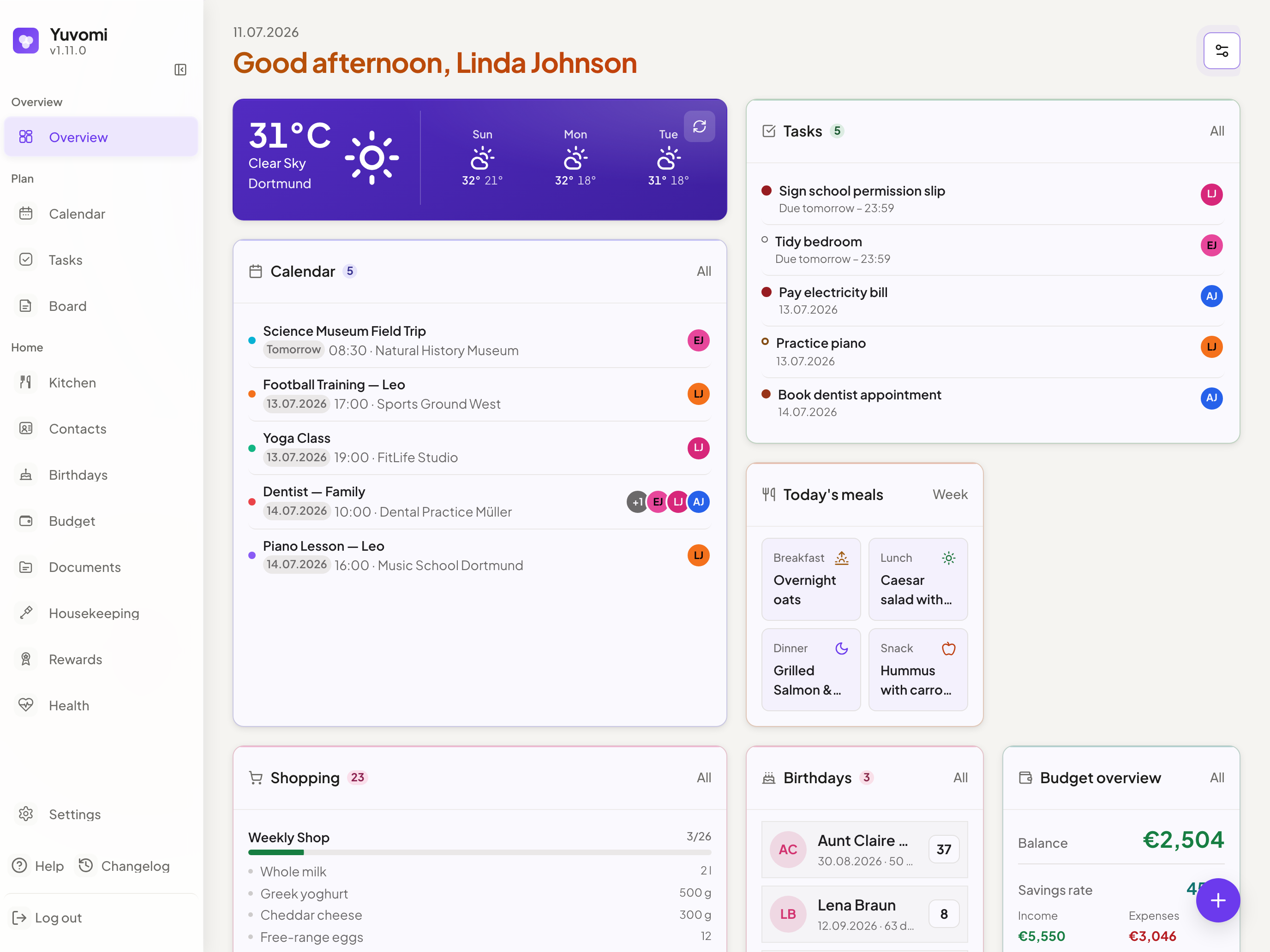
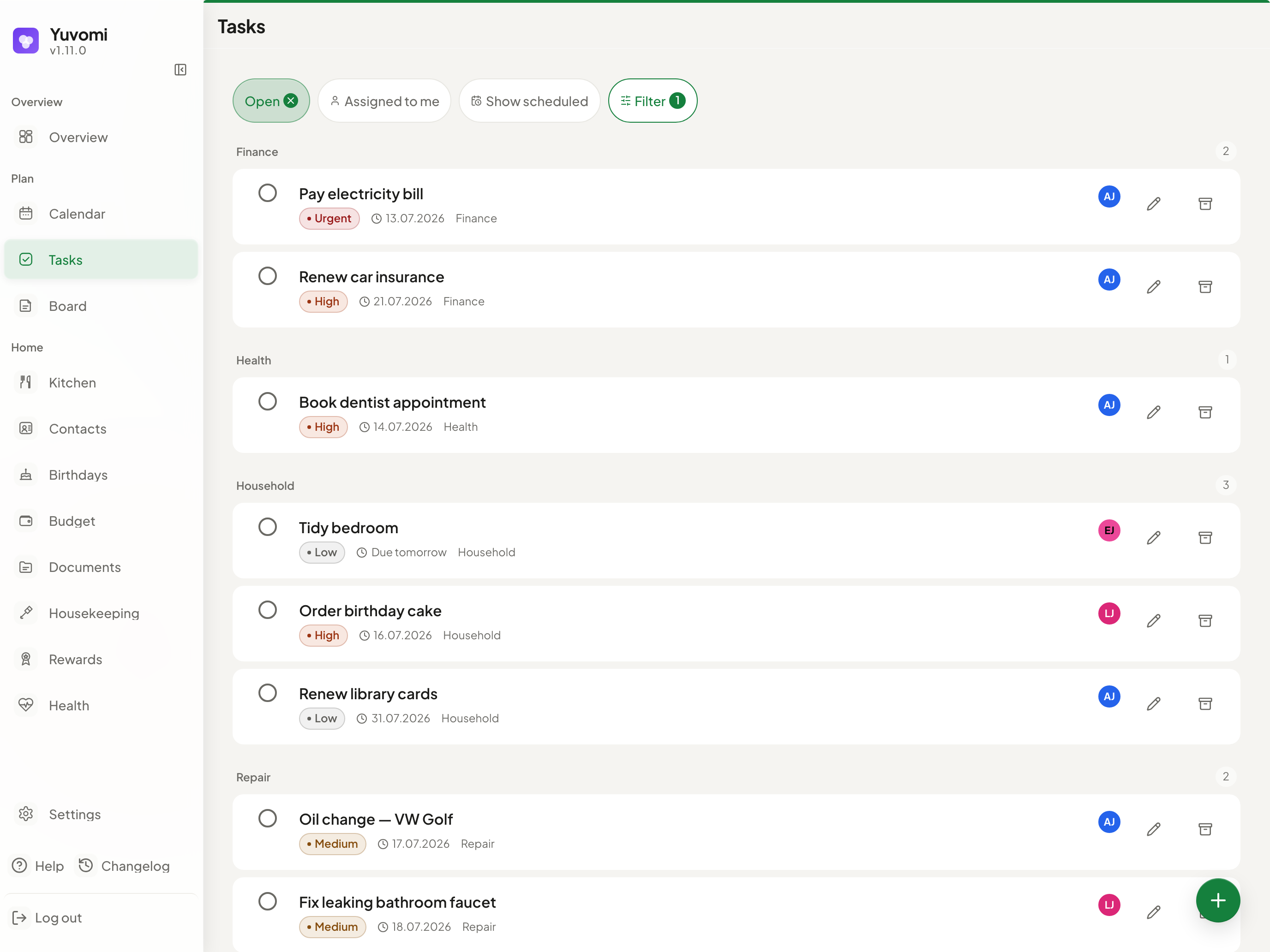
Self-hosted family planner for tasks, calendar, shopping, meals, and budget
Alternative to: cozi, familywall, skylight
About
Versions (423)
v2.88.0
2026-11-10Foundation
- The web app now ships built, bundled and minified by Vite 8 with source maps, and the
service worker takes its offline list from the build instead of a hand-kept one; pages,
offline reach and the module API for third-party modules (
/api.js,/i18n.js,/utils/html.js) stay the same, so nothing changes on screen. - The release tarball carries the built app in
dist/next to the source, together withTHIRD-PARTY-NOTICES.txt; the server starts only from a build and says so whendist/is missing. - For module authors: only
/api.js,/i18n.jsand/utils/html.jsstay importable. Until now a third-party module could import any app file, for example/utils/page-layout.js; with this release every other file ships inside the bundle under a hashed name, and such an import stops the module from loading. Import only these three paths and build the page markup yourself (the example in MODULES.md shows how). - Yuvomi now needs Chrome and Edge 105, Firefox 115 or Safari 15.4 (iOS 15.4 on iPhone and iPad). Until now it still started down to Chrome 87, Firefox 79 and Safari 14.1 (iOS 14.5); on Chrome 87 to 98 and Safari or iOS 14.1 to 15.3 it no longer does. Update the browser or the device’s system, or use another browser. Those browsers, and Firefox before 97, now get a short page in German or English that names the versions and the way out, instead of an empty app; Chrome 99 to 104 and Firefox 97 to 114 still start, with single screens that can stay empty. The offline page now speaks English as well as German, and the supported browsers are documented as one list instead of two.
- Menus behind a button now open on Firefox ESR 115 and Safari 15.4 to 16 (and Chrome 105 to 113): every “more” menu, the account menu, filters and the date field’s calendar stayed closed there. Those browsers now load a small polyfill for the Popover API; newer browsers load nothing extra.
npm run devnow starts Vite on port 5173 in front of the Express server, which keeps serving the API on 3000;npm run buildmakes the production build.- The contributor rules now state what the project guarantees instead of which tools it avoids. CONTRIBUTING.md replaces “no frameworks, no build tools” with five guarantees (no runtime CDN, no telemetry, third-party code pinned and listed, markup built as DOM, a reproducible build with two attested release artifacts), describes the build and the type check, and docs/DECISIONS.md records the build step, the Node floor and the position on hosting as entries 20 to 22.
- The way back to 2.87.0 was tried before the tag. Image 2.87.0 and this build ran in turn
on the same demo database, in production mode with a generated encryption key. Neither start
applied a migration, every module answered the same through the API before and after, and
the service worker switched from 2.87.0 to 2.88.0 and back without an error screen or a
failed request, with the session staying signed in. A backup made on 2.88.0 restored on
2.87.0 through the admin restore. To go back, pin the image tag
2.87.0.
Changed
- Running Yuvomi outside a container now needs Node.js 24.12 or newer.
package.jsonaccepts Node 24.12 and later (24.x and 26 and up) instead of 22.14 and 23.6; the tests run on 24 and 26 and no longer need the SQLite flag. Anyone who still runs a bare-metal install on Node 22 sees a one-line message at start that names the supported range; update Node, then start again. The container image is unchanged and already runs on Node 24.
Fixed
- The in-app changelog shows a summary whole when it runs over two lines. An entry whose bold first sentence wrapped in the source lost the end of that sentence to the text below it, so the short form read ”… on iPhone and” with “iPad).” opening the reason. This hit 154 entries since 2.45.0; summary and reason are now split where the sentence ends.
- Birthdays no longer rewrite their calendar entries every minute. The check that keeps a birthday’s calendar entry and reminder in step runs once a minute for every account, and on every visit to the birthday list. It wrote each entry again even when nothing had changed, which also rebuilt the entry in the search index: constant small writes to the database, on a NAS or a Raspberry Pi to its disk or SD card. It now writes only what differs.
- Pages open from the app’s cache without a round trip to the server. The service worker
asked the network first for every page and module before handing out the copy it already
held, although the built files under
/assets/carry a hash of their content in the name and never change under it; it now serves them straight from its cache and fetches only a file that is missing. Files without a hash, such asindex.htmland/api.js, still come from the network first. The PDF viewer (pdf.js) also no longer lands in the worker’s cache after the first opened document: documents are not available offline, so it is left to the browser. - On a phone, the tool row of Recipes, Pantry, Meals and Shopping folds away on scroll in browsers that need the menu polyfill too. The rule that folds it keeps the row while one of its menus is open, and it asked for that with a selector those browsers do not know, so they dropped the whole rule and the row kept its space above the list. It now has a second rule that asks the way the polyfill marks an open menu.
- An up-to-date browser that lands on the “browser too old” page now returns to the app on its own. Opened from a bookmark, or reloaded after a browser update, the page kept saying the browser was too old until you pressed “Try again”; it now runs the same check as the app and sends a browser that passes it back to the start page. A browser that is too old stays on the page. The page and the offline page also no longer request a language file they never use.