
LiftTrace
Self-hosted weightlifting tracker with programs, PR tracking, and an AI coach
Alternative to: strong, hevy
v1.0.1
2026-07-25Added
-
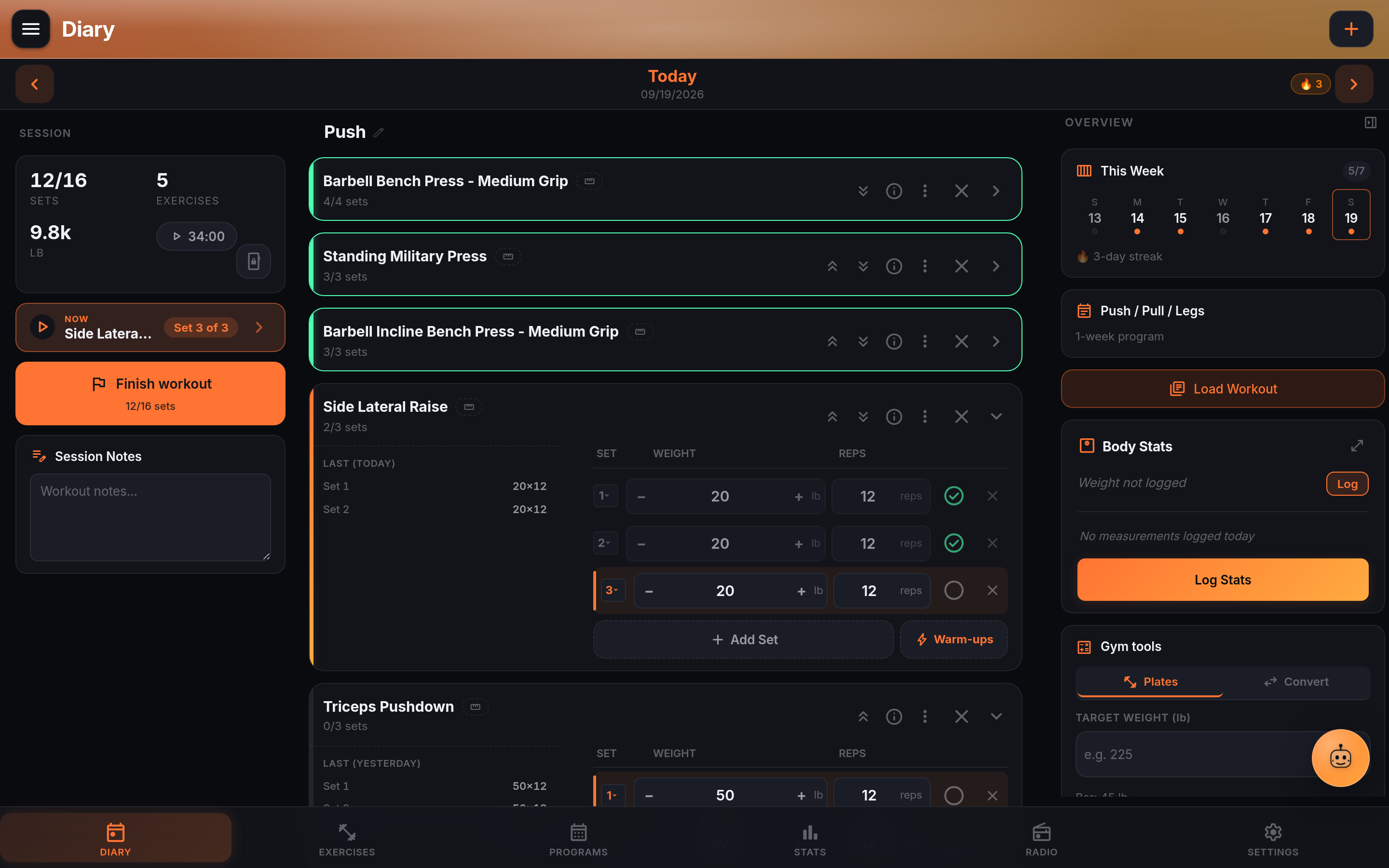
Multi-Week Progression Plans (#13). Programs can now span a training block of multiple weeks, with a per-week Sets / Reps / Tempo / Rest / Load matrix instead of one flat prescription. Set a program’s Duration (weeks) and the Workout editor gains a Week tab strip (with a “copy this week → next” shortcut) plus new Tempo and Rest (s) fields. The Diary resolves which week you’re on — by default advancing as you log sessions (calendar mode optional) — and prefills that week’s targets when you load the workout; inside a programmed block the plan’s prescription wins over last-session auto-fill. A per-exercise Rest feeds the rest timer. Repeat or regress a week from the Load Workout sheet, and choose whether the plan holds on the final week or repeats. Existing single-week programs are unchanged.
-
SSO-only mode via environment variable (#16). Set
OIDC_ENABLE_EMAIL_PASSWORD_LOGIN=0(orfalse/no) at boot to disable password login server-wide, so users must sign in via an OIDC provider. Locks the corresponding admin UI toggle with an env-lock note. Mirrors the pattern across the TraceApps family. -
/api/auth/statusnow returns configured OIDC providers so the Android app can render OIDC sign-in buttons on first install, before the user has a session. -
“Custom…” option on the Model dropdown for Claude, OpenAI, and Gemini. Enter any model ID the vendor supports without waiting for the preset list to catch up. Same behavior the OpenAI Compatible provider has always had.
-
Retirement remap for retired Gemini models. Saved selections of
gemini-1.5-*orgemini-2.0-*(both retired by Google) are quietly upgraded to the current default at request time, avoiding 404s. -
Settings search covers new territory:
garmin, SMTP test, voice input, custom exercises.
Changed
- Claude model presets refreshed. Sonnet bumped to Sonnet 5, Opus 4.8 added as a “smartest” tier option, older Sonnet 4.6 removed.
Fixed
-
OIDC sign-in now works on Android first-install for OIDC-only servers. NativeSetup previously required a username + password to submit, blocking users on Authentik / Keycloak / Authelia-backed servers with password login disabled. The setup form is now a two-step flow: enter server URL → app fetches
/api/auth/status→ renders whichever auth methods the server actually supports (password fields only when enabled, OIDC provider buttons with logos when configured, both when both). -
OIDC callbacks no longer fail on the first attempt with a spurious
callback_failed. openid-client v5’s default 3.5 s outgoing HTTP timeout was tight enough that cold token-exchange requests to slower IdPs would sometimes time out. Bumped to 10 seconds. -
Sets logged just before backgrounding the phone are no longer lost. The debounced save timer now flushes pending writes on
pause,visibilitychange, andpagehide, so a set entered right before switching apps is guaranteed to hit the server or the local queue instead of dying with the timer. -
Advance-week button correctly disables in edge cases — tightened the check so the button doesn’t invite you into a state it can’t actually enter.
Security
- fast-uri bumped to 3.1.4 (GHSA-4c8g-83qw-93j6, high). ReDoS in URI parsing.
- brace-expansion bumped to 5.0.8 (GHSA-mh99-v99m-4gvg, high). DoS via unbounded expansion length.
- body-parser bumped to 2.3.0 (GHSA-v422-hmwv-36x6, low). DoS when an invalid
limitvalue silently disables size enforcement.