
Tribu
Self-hosted family organizer for calendar, tasks, shopping, and more
Alternative to: cozi, familywall, ourhome
v2026-09-27
2026-09-27Highlights
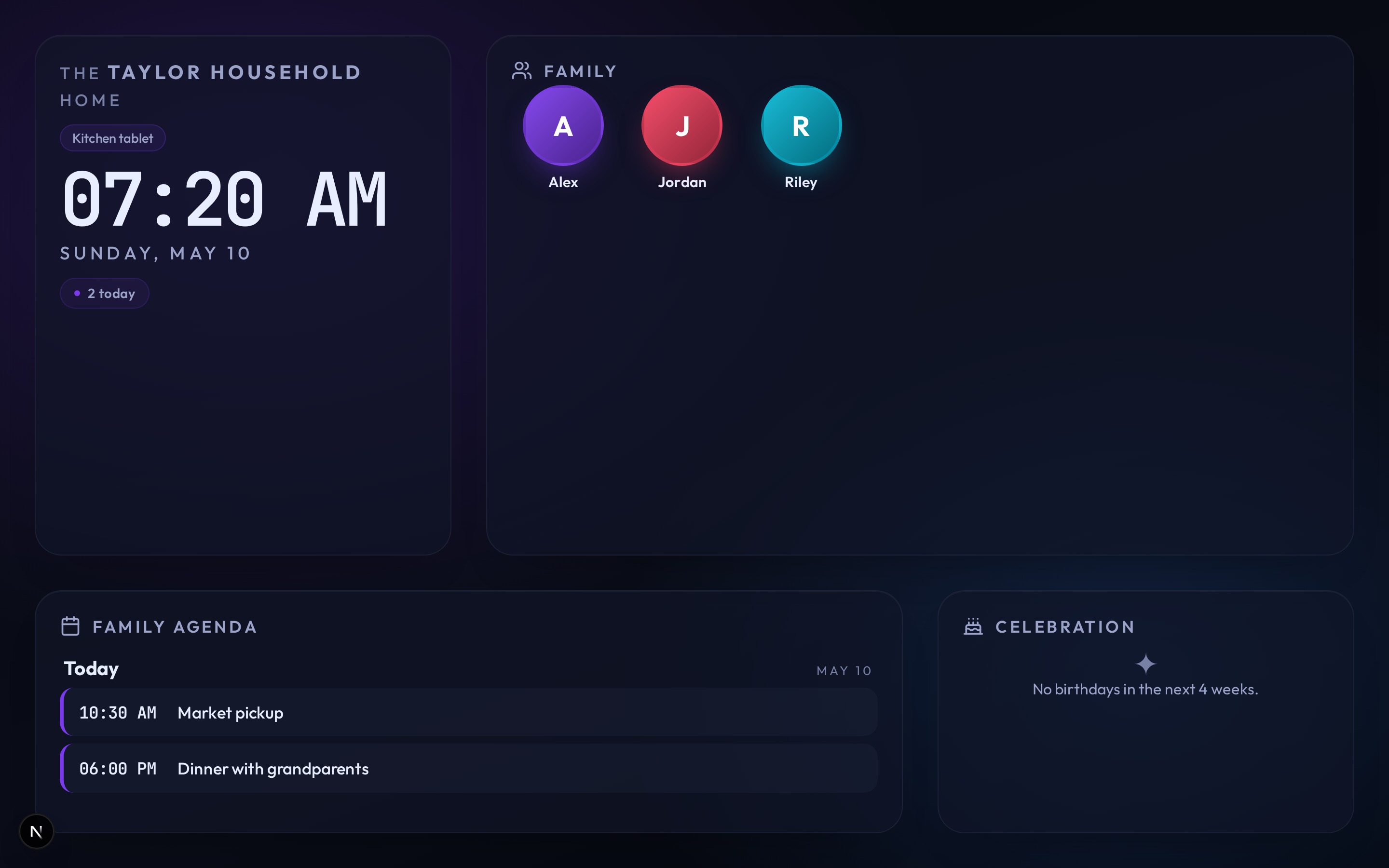
Home Family Display 2.0
The shared display is rebuilt around a calm “stage” for kitchen tablets and hallway screens. Fixed anchors (clock, greeting, weather, Next up and a timeline per person) stay in place, while four areas rotate between cards such as meals, shopping, weather, reminders, school timetables, countdowns, stars, birthdays, people and the week. (#486)
- Admins choose the cards and the rhythm of each area, times of day, night dimming, language and e-ink size, and set a family weather place (forecasts from Open-Meteo). (#487)
- E-ink frames without a browser (TRMNL, ESPHome, Inkplate) can load the display as a picture from
/display/image.png. (#488) - New tablet displays show their pairing link as a QR code for the display mode of the upcoming Tribu Android app. (#489)
- A display that cannot load says why and retries every 15 seconds. (#505)
- The display editor offers the weather place right where a weather card has none. (#506)
A new look across Tribu
The dashboard, calendar, settings, shopping and family administration adopt the new warm, playful design. (#474, #475, #477, #478, #480)
- Phones get a responsive planner with month, week and agenda views, and a shared mobile navigation with Home, Calendar, New, Shopping and More. (#479)
- The More sheet groups all areas and has a search; the New sheet shares the same bottom sheet. (#483, #484, #485)
Shopping
- Product tiles with illustrations, notes, photos and urgency, moving products between lists, a focused shopping mode, and restoring recently bought products. (#478)
- Category suggestions, explicit check-off controls with Undo, and the category overview shows open items only. (#473)
- Family-wide store search links, so items can be searched online. (#463)
Tasks on your phone
Opt-in VTODO task sync lets Apple Reminders and DAVx5-compatible task apps create, edit and complete Tribu tasks with a dedicated task token. Unsupported DAV writes are rejected cleanly. (#459, #460)
Reliability
- The backend runs two worker processes when Valkey is configured, so Tribu keeps answering while a crashed worker restarts. Scheduled jobs run in one worker at a time, and live shopping updates and rate limits are shared through Valkey. (#502)
- New Admin → System shows the running version, memory use and unexpected restarts. Repeated crashes notify the instance admin. (#501)
- Fixed a display request that could exhaust the backend’s memory with larger profile pictures and school timetables, and a crash of dashboards when a birthday falls on 29 February. (#491, #490)
- Calendar reminders arrive on time with an absolute start time, and Android notification icons render correctly. (#471)
- The misleading
DAV_STORAGE_FOLDERwarning is gone; DAV data has always lived in the database. (#500)
Privacy
Profile pictures are served as small square WebP images, and Tribu now stores profile pictures and product photos at most 1024 px in size and without metadata, so camera location data no longer stays on the server. (#492, #504)
Upgrade notes
- Stored photos are converted and this cannot be undone. On the first start, migration 0061 replaces stored profile pictures and shopping product photos with bounded WebP versions without metadata. If you want to keep the original uploads, take a backup before updating.
- Two backend workers. With
REDIS_URLset, as in the reference compose file, the backend starts two workers and needs roughly 150–200 MB more memory. SetTRIBU_WORKERSto choose the number yourself; without Valkey one worker runs as before. - New
stableimage tag that follows releases only;lateststill follows every merge. See Image tags for pinning and rollback. (#507) - All other database migrations run through Tribu’s normal upgrade path.
Security and maintenance
- The whole backend test suite now runs in CI, and the heaviest endpoints are checked against size and memory budgets with a realistic family on PostgreSQL. (#503)
- Backend and frontend dependency updates. (#461, #462, #464–#470, #481, #482)
Full changelog: https://github.com/itsDNNS/tribu/compare/v2026-08-21…v2026-09-27