
Kept Notes
Google Keep-style notes app for quick capture, on your own server
Alternative to: google keep
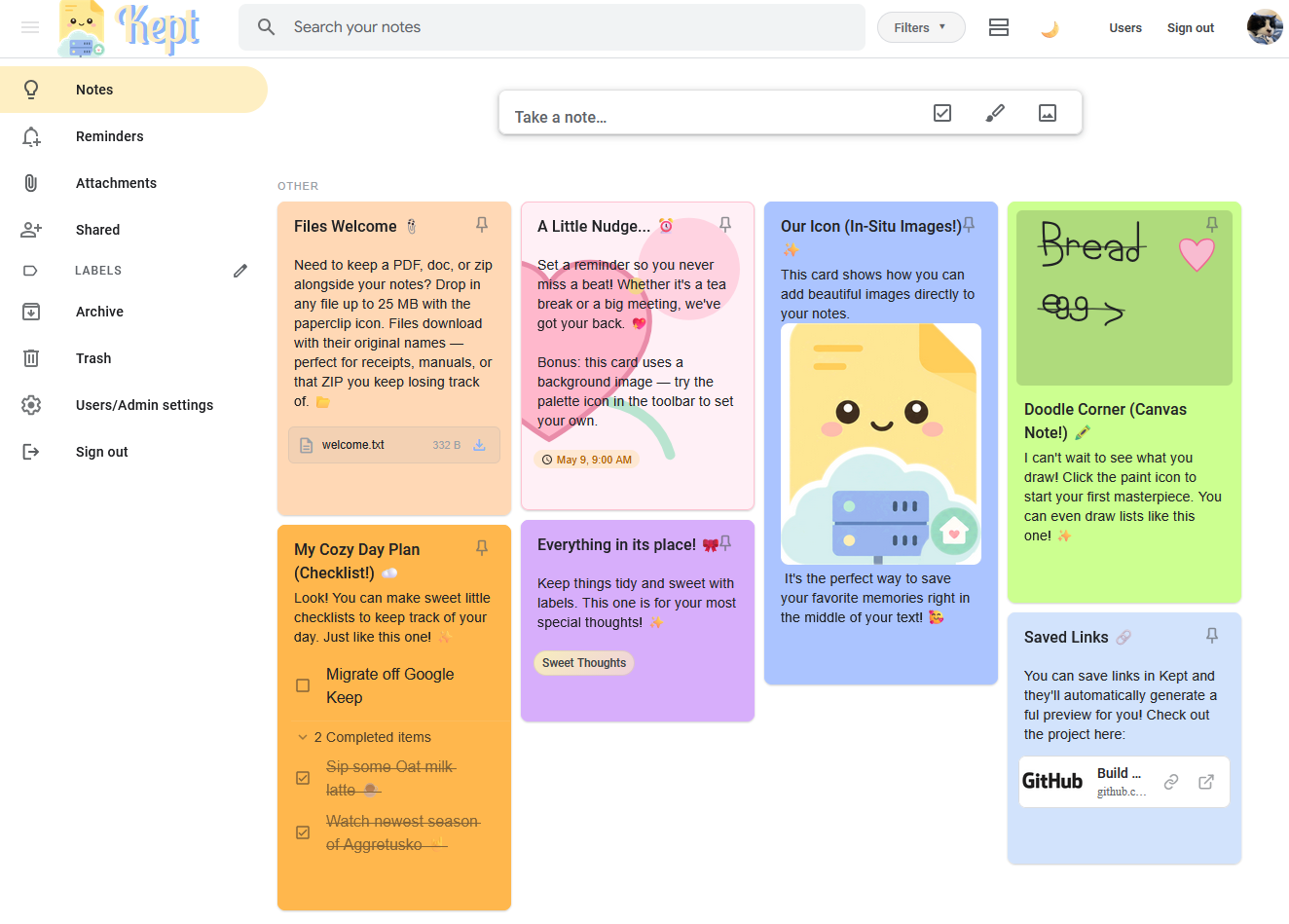
Kept is a notes app built for quick capture: text notes, nested checklists, images, drawings, links, attachments, labels, colors and reminders. Self-host it with Docker for web access, real-time sharing and sync across devices, with Google Keep Takeout import, local accounts, optional 2FA and OIDC single sign-on.
Kept Notes Docker Compose example
Self-host Kept Notes on your own server, homelab, or VPS starting from this Docker Compose example.
It runs Kept Notes in Docker containers using the official ghcr.io/ericerkz/kept:latest image, with persistent volumes and automatic restarts preconfigured.
Review the environment variables and adjust them to your setup, save the file as compose.yml (or docker-compose.yml), and start the stack with docker compose up -d.
services:
  kept:
    image: ghcr.io/ericerkz/kept:latest
    volumes:
      - data:/app/data
    restart: unless-stopped
    environment:
      NODE_ENV: "production"
      # Port the Kept web server listens on inside the container.
      PORT: "6767"
      # Location of the SQLite database inside the data volume.
      SQLITE_PATH: "/app/data/kept.sqlite"
      # Linux user ID the app runs as; files in the data volume are owned by it.
      PUID: "1000"
      # Linux group ID the app runs as.
      PGID: "1000"
      # Public origin of this instance (e.g. https://kept.example.com, no path). Required for OIDC sign-in and remote MCP/OAuth; leave empty to derive it from the request.
      BASE_URL: ""
      # Allow cross-origin requests from any origin (needed by the native iOS/Android apps and API clients only when an origin allowlist is not set). Set to "0" to disable.
      KEPT_CORS_ALLOW_ALL: "1"
      # Comma-separated list of allowed browser origins (scheme + host + port, no trailing slash). Takes precedence over KEPT_CORS_ALLOW_ALL when set.
      KEPT_CORS_ORIGINS: ""
      # Session lifetime in days before users must sign in again.
      KEPT_SESSION_TTL_DAYS: "30"
      # OpenID Connect issuer URL for optional single sign-on (callback: <BASE_URL>/api/auth/oidc/callback). Leave empty to disable SSO.
      KEPT_OIDC_ISSUER: ""
      # OIDC client ID registered at the provider.
      KEPT_OIDC_CLIENT_ID: ""
      # OIDC client secret registered at the provider.
      KEPT_OIDC_CLIENT_SECRET: ""
      # Label shown on the single sign-on button.
      KEPT_OIDC_NAME: "Single sign-on"
      # OIDC scopes requested from the provider.
      KEPT_OIDC_SCOPES: "openid profile email"
      # SMTP server for invite-by-email. Leave empty to hide the invite-by-email feature.
      KEPT_SMTP_HOST: ""
      # SMTP server port.
      KEPT_SMTP_PORT: "587"
      # Set to "1" for implicit TLS (usually port 465); "0" uses STARTTLS.
      KEPT_SMTP_SECURE: "0"
      # SMTP username.
      KEPT_SMTP_USER: ""
      # SMTP password.
      KEPT_SMTP_PASS: ""
      # From address on invite emails.
      KEPT_SMTP_FROM: "Kept <no-reply@example.com>"

volumes:
  data:
Prefer a managed setup? WinterFlow installs, configures, and updates Kept Notes for you using this same Docker Compose configuration.